
4.7T MRI for Translational Research Animal Facility
We are proposing to obtain a Bruker Biospin Advance Neo 47/40 USR pre-clinical MR imaging system with Paravision 360 software, including a 4.7T (Tesla) 40 cm magnet, gradient and shim coils (main and upgraded one for rodents), gradient/shim cooling, RF amplifiers, shim amplifier, Faraday cage, several RF volume and planar surface coils. For the proposed […]
Molecular Regulation of Cell Development and Differentiation Phase III COBRE
Funds are requested to renew a Center of Biomedical Research Excellence (COBRE) at the University of Kansas Medical Center (KUMC) as a Phase III, five year award. This COBRE has a research focus on the regulation of cell development and differentiation, which may provide new, therapeutic insights into a host of developmental abnormalities and diseases. […]
National IDeA Symposium of Biomecical Research Excellence
The Institutional Development Award (IDeA) Program within the National Institute of General Medical Sciences (NIGMS) promotes the development, coordination and sharing of research resources that increase the competitiveness of investigators in 23 IDeA-eligible states and Puerto Rico. The IDeA Program includes the Centers of Biomedical Research Excellence (COBRE), the IDeA Networks of Biomedical Research Excellence […]
Upgrade to 9.4T Animal MRI Scanner: Midwest Regional Resource
This proposal requests support for new animal MRI scanner electronics system that will replace an obsolete system and provide dramatically improved capabilities. Once installed, this state-of-the-art system will support research from NIH-funded investigators representing four IDeA State institutions in the Midwest: University of Kansas Medical Center, University of Kansas-Lawrence, Kansas State University, and Pittsburg State […]
Console Upgrade and Cryogenic Probe for a 500 MHz NMR System for Biomedical Research
The Mary L. Vanier Biomolecular NMR Facility at Kansas State University, which has served more than 30 separate NIH-funded research projects and several other life sciences research groups (Total 45), requests partial funding to replace an obsolete Varian 500 MHz NMR system (originally purchased in 1993) with a newer console and a 5 mm cryogenic-probe. […]
The Effects of Differential Rearing on Glutamate Homeostasis and Addiction
Rodents reared in enriched conditions (EC) during childhood and adolescence have a variety of neurobiological and behavioral differences when compared to rodents reared in standard (SC) or isolated conditions (IC). These neurobiological differences impact numerous behaviors, including the response to drugs of abuse. The neurobiological mechanism for this effect remains unclear. Glutamatergic afferents to the […]
Progression of DCIS to Invasive Breast Cancer through CCR2 Chemokine Signaling
About 50,000 cases of ductal carcinoma in situ (DCIS) are diagnosed in the US every year, making DCIS the most common type of non-invasive breast cancer diagnosed in women. Up to 20% of all patients will experience disease recurrence accompanied by invasive ductal carcinoma (IDC). Current cyto- and histopathological approaches do not accurately predict disease […]
Kansas IDeA Network of Biomedical Research Excellence
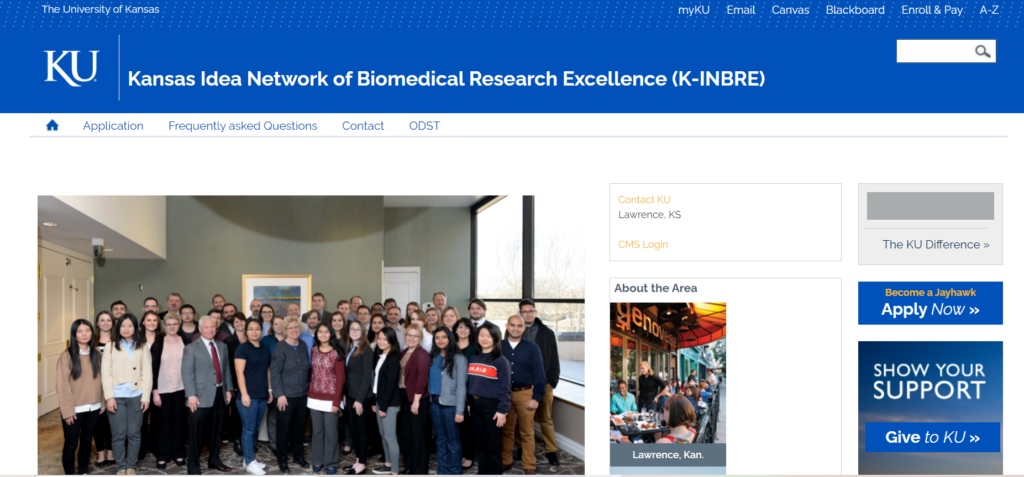
The Kansas IDeA Network of Biomedical Research Excellence (K-INBRE) is a statewide network of graduate and undergraduate universities in Kansas and Oklahoma that work cooperatively to improve biomedical research in Kansas. Kansas formed such a network in 2001 (Kansas BRIN) and has successfully continued as the Kansas INBRE. The University of Kansas Medical Center (KUMC) […]
Interdisciplinary Research in Vascular Biology
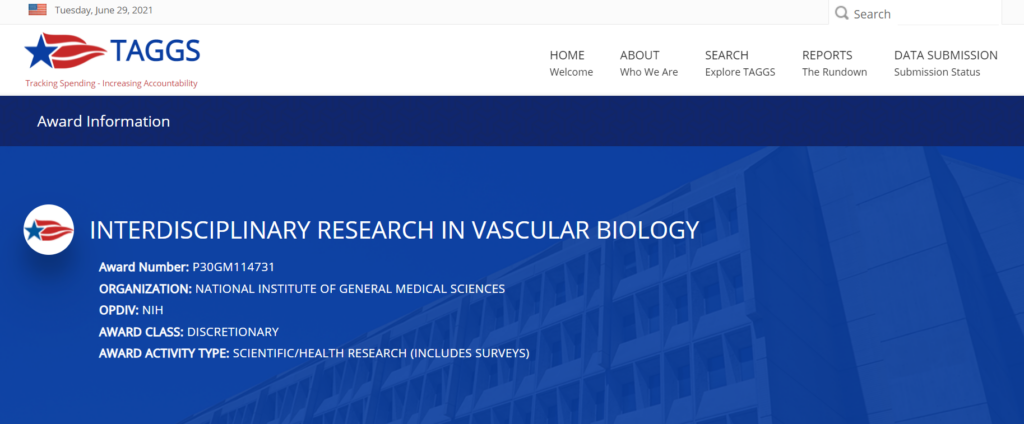
In this COBRE Phase III application, we will move to independence a world-class center of excellence in vascular biology at the Oklahoma Medical Research Foundation (OMRF). In Phases I and II, we fostered vascular biology research through a multidisciplinary approach. Mentoring launched the independent careers of outstanding junior investigators, who developed innovative new technologies, published […]
Data Sharing Practices and Reproducibility of Addiction Clinical Trials
An estimated 75%–90% of scientific experiments are not reproducible, resulting in $28 billion per year spent on irreproducible research in the United States alone. One promising solution to irreproducible clinical research is to publicly share trial data. However, journal editor and funding agency positions on data sharing, as well as the extent of reproducibility of […]