
Center for Diagnostic and Therapeutic Strategies in Pancreatic Cancer
(Center for Diagnostic and Therapeutic Strategies in Pancreatic Cancer) In spite of notable advances in detection and treatment of various cancers, pancreatic cancer is one of the leading causes of cancer-related deaths in both men and women in the U.S. with a 5-year survival rate of less than 6%. A lack of early symptoms, short […]
Center for Excellence In-Host Pathogen Interactions
The objective of this grant application is to establish a Center of Biomedical Excellence in Host- Pathogen interactions that is highly interactive and consists of a dynamic group of junior investigators whose research focus is on understanding the mechanisms that underline the host respose to various infectious agents. We have proposed five new independent, but […]
Indigenous Trauma & Resilience Research Center
Indigenous populations experience significant trauma-related health disparities, including addiction, post- traumatic stress disorder, chronic diseases, infant mortality, and suicide. Many of these disparities are worse for American Indians (AIs) in the Dakotas. AI communities also contend with historical and intergenerational trauma from decades of traumatic losses and forced assimilation. Hence, we will establish the Indigenous […]
Center for Biobehavioral Mechanisms of Eating Behavior
We propose to establish a Center for Bio-behavioral Mechanisms of Eating Behavior (CBM-EB) at Sanford Research, Fargo along with the University of North Dakota School of Medicine and North Dakota State University (NDSU). The proposed CBM-EB will initially consist of five thematically related research projects focusing on mechanisms related to eating disorders and maladaptive eating […]
Center for Population Health Research
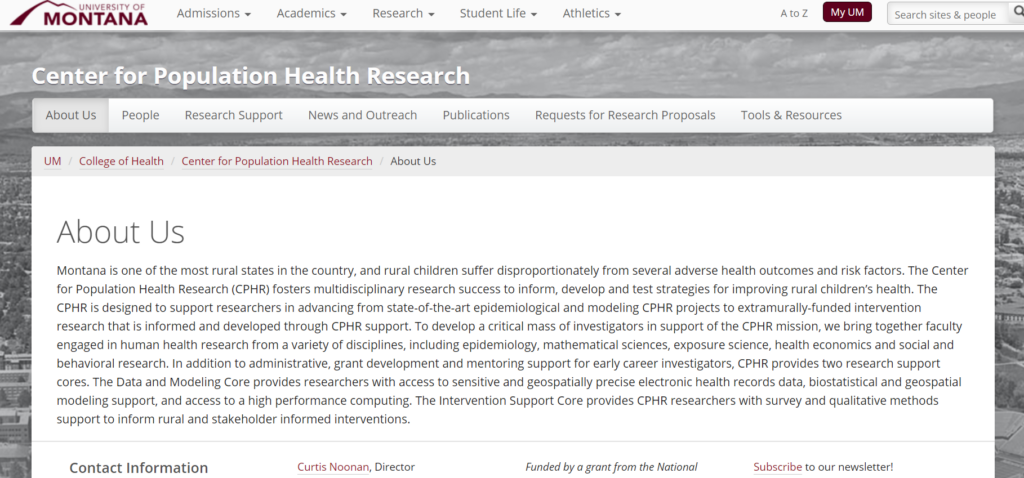
It is well understood that rural populations, especially rural children, suffer disproportionately from several chronic diseases and risk factors that adversely impact quality of life. For example, rurality is associated with higher infant mortality, increased rates of lower respiratory tract infection hospitalization among infants and young children and lower rates of early childhood vaccinations for […]
Biomolecular Structure and Dynamics
The Center of Biomedical Research Excellence in Biomolecular Structure and Dynamics at the University of Montana (CBSD COBRE) supports research that applies the methods and concepts of biophysics, structural biology and chemistry to understand the mechanistic basis of biological processes in health and disease. CBSD faculty members are drawn from the basic and biomedical sciences […]
Center for American Indian and Rural Health Equity
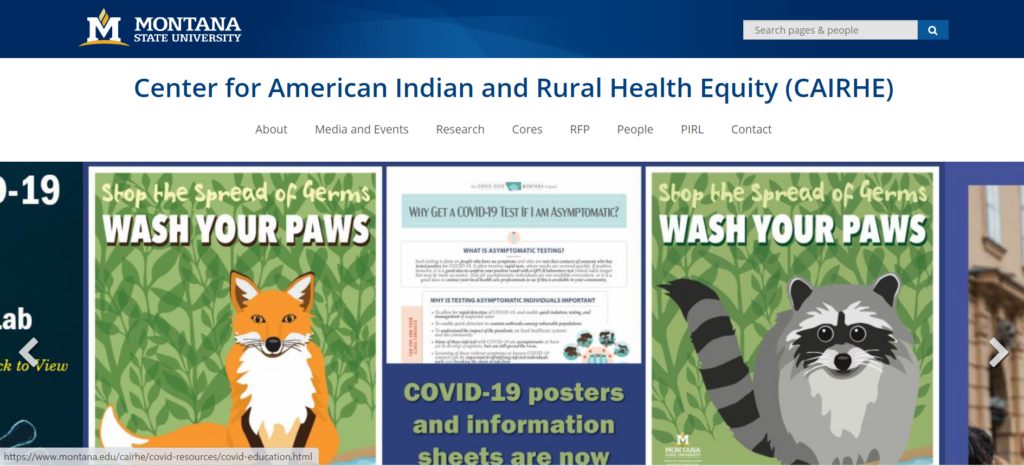
The mission of the Center for American Indian and Rural Health Equity (CAIRHE) is to reduce significant health disparities in Native and rural communities across Montana while developing junior faculty into a multidisciplinary cohort of independent health equity investigators. The Center achieves its mission through community-based participatory research (CBPR) and public health interventions that are […]
Identification and Dynamics of SARS-CoV-2 Sequence Variants in Idaho

The first SARS-CoV-2 sequence published provided the foundation by which all currently approved detection methods and vaccines have been developed. However, variants of SARS-CoV-2 that carry multiple changes to their genome may enable the virus to evade detection and escape natural or vaccine-induced immunity, thwarting current abatement efforts. Additionally, variants that increase transmissibility, enhance disease […]
Center of Biomedical Research Excellence in Matrix Biology Phase II

The long-term goal of the Center of Biomedical Research Excellence (COBRE) in Matrix Biology is to establish, enhance, and actively advance a multidisciplinary research center focusing on improving our understanding of the role of the extracellular matrix in development, health, and disease, and contributing to the prevention, treatment, and cure for diseases of high priority. […]
Center for Modeling Complex Interactions
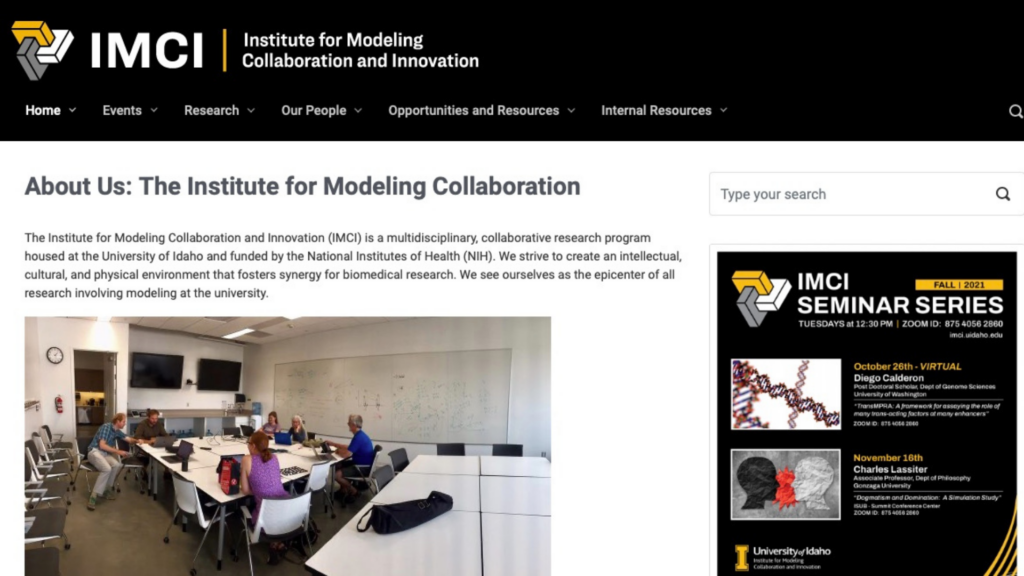
Biomedical problems are innately complex, and their solutions require input from many fields. Many centers focus on a single disease or organ system. By contrast, the Center for Modeling Complex Interactions focuses on an approach that can address many biomedical problems: team-based, interdisciplinary research centered around modeling. Our goal is to support and facilitate biomedical […]