
Activity-dependent energy homeostasis at the presynaptic terminal

This work is relevant to both normal aging and pathologies like Alzheimer’s disease, where brain function is impaired due to defective mitochondrial respiration and loss of cellular energy. The long-term goal of this project is to ameliorate neurotransmission defects due to mitochondrial dysfunction, as a way to stop disease progression to later degenerative stages, increasing […]
Deep sequencing SARS-CoV-2 samples from New Mexico to interrogate immunological selection on genetic variants
Although vaccination has blunted the impact of the SARS-CoV-2 pandemic in several countries, the future impact of this virus will depend on its transmissibility, virulence, and ability to evade naturally-acquired and vaccine- mediated immunity. All three phenotypes are currently in flux due to the evolution and spread of novel SARS- CoV-2 variants of concern. Importantly, […]
Clinical and Translational Research Infrastructure Network IDeA-CTR

The diverse Mountain West (MW) population continues to be plagued by high rates of health disparities (HD) and lower life expectancy rates when compared to the rest of the US1. The MW Clinical and Translational Research Infrastructure Network (CTR-IN) was established in 2013. During the last 4 years, we have created an impactful and transformative […]
Effect of Vaping on Lung Immunity
Autophagy is a fundamental homeostatic and metabolic intracellular process operational in all healthy human cells. Autophagy sustains cellular metabolic needs during starvation or growth factor withdrawal, cleanses the cell interior by removing damaged organelles and toxic protein aggregates, and rids cells of endogenous or exogenous promoters of inflammation. Increasingly studied, autophagy broadly affects human health […]
Center for Population Health Research
It is well understood that rural populations, especially rural children, suffer disproportionately from several chronic diseases and risk factors that adversely impact quality of life. For example, rurality is associated with higher infant mortality, increased rates of lower respiratory tract infection hospitalization among infants and young children and lower rates of early childhood vaccinations for […]
Biomolecular Structure and Dynamics

The Center of Biomedical Research Excellence in Biomolecular Structure and Dynamics at the University of Montana (CBSD COBRE) supports research that applies the methods and concepts of biophysics, structural biology and chemistry to understand the mechanistic basis of biological processes in health and disease. CBSD faculty members are drawn from the basic and biomedical sciences […]
Center for American Indian and Rural Health Equity

The mission of the Center for American Indian and Rural Health Equity (CAIRHE) is to reduce significant health disparities in Native and rural communities across Montana while developing junior faculty into a multidisciplinary cohort of independent health equity investigators. The Center achieves its mission through community-based participatory research (CBPR) and public health interventions that are […]
Identification and Dynamics of SARS-CoV-2 Sequence Variants in Idaho

The first SARS-CoV-2 sequence published provided the foundation by which all currently approved detection methods and vaccines have been developed. However, variants of SARS-CoV-2 that carry multiple changes to their genome may enable the virus to evade detection and escape natural or vaccine-induced immunity, thwarting current abatement efforts. Additionally, variants that increase transmissibility, enhance disease […]
Center of Biomedical Research Excellence in Matrix Biology Phase II

The long-term goal of the Center of Biomedical Research Excellence (COBRE) in Matrix Biology is to establish, enhance, and actively advance a multidisciplinary research center focusing on improving our understanding of the role of the extracellular matrix in development, health, and disease, and contributing to the prevention, treatment, and cure for diseases of high priority. […]
Center for Modeling Complex Interactions
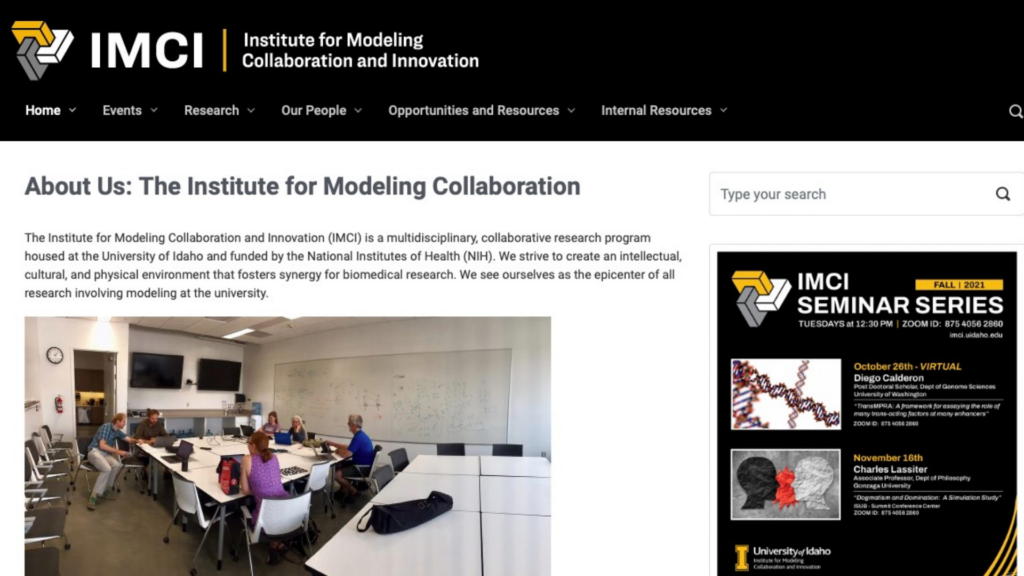
Biomedical problems are innately complex, and their solutions require input from many fields. Many centers focus on a single disease or organ system. By contrast, the Center for Modeling Complex Interactions focuses on an approach that can address many biomedical problems: team-based, interdisciplinary research centered around modeling. Our goal is to support and facilitate biomedical […]