
Advancing Competitive Biomedical Research in Puerto Rico

This renewal application of the Puerto Rico IDeA Networks of Biomedical Research Excellence (PR-INBRE) will reinforce the original goal to strengthen the biomedical research capacity in Puerto Rico by serving as a platform for conducting multidisciplinary research. This objective will be augmented by the support of four thematic focus areas: Neuroscience, Molecular Medicine, Drug Development, […]
Alaska INBRE 4 One Health

Since 2014, AK INBRE 3 has enhanced the research capacity of developing faculty and investigators throughout its network of University of Alaska universities by awarding pilot research grants, providing salaries to technicians, training of post-doctoral scientists and graduate and undergraduate students, and supporting travel, science advising, and equipment purchases. AK INBRE 3 provided support for […]
Bacterial Mechanisms for Establishing and Maintaining Cell Polarity

Many rod-shaped bacteria are polarized, meaning that one end of the cell is morphologically and functionally distinct from the other, but there is a general lack of understanding of the mechanisms by which polar asymmetry is established and maintained. Since polarized features provide critical spatial cues for many processes, including chromosome segregation and cell growth, […]
Wyoming Sensory Biology COBRE
Abstract The primary mission of the Wyoming Sensory Biology COBRE (SBC) is to foster and conduct high-quality scientific research that advances the understanding of our sensory systems and disorders related to them. SBC will accomplish its mission through the augmentation and strengthening of UW’s institutional biomedical research capacity. This will be accomplished through building a […]
Wyoming IDeA Networks for Biomedical Research Excellence Phase 4

Wyoming INBRE Project Summary. The University of Wyoming (UW) is a land-grant institution and the only baccalaureate, post-secondary degree-granting institution in the State of Wyoming. This application is for a continuation of previous IDeA program awards managed through NIGMS (P20RR016474, 5P20GM103432). The long-term programmatic goal to establish a statewide network for biomedical research and excellence […]
Tcf21 and visceral adipose tissue development and expansion

Tcf21 and visceral adipose tissue development and expansion: White adipose tissue (WAT) is divided into two categories, visceral adipose tissue (VAT) and subcutaneous adipose tissue (SAT), based on their anatomical locations. A specific positive correlation has been suggested between pathologic VAT expansion and insulin resistance, which makes VAT a potential target for treating metabolic diseases […]
Regulation of Ocular Angiogenesis by microRNAs

Regulation of Ocular Angiogenesis by microRNAs: Anti-VEGF therapy is the current mainstay for treating wet age-related macular degeneration (AMD). The efficacy of anti-VEGF therapy is still limited, and some patients failed to respond to the treatment. No drug is currently available for subretinal fibrosis associated with AMD. Therefore, there is a great need for developing […]
Immunotherapy of KPC Infection
Immunotherapy of KPC Infection: A continued and emerging threat to human health are multi-drug resistant bacterial infections. Among these threats, carbapenemase producing strains of Klebsiella spp has been recognized by the World Health Organization and the Centers for Disease Control has a global threat to human health particularly in the hospital setting. Clinically these infections […]
Effects of E-Cigarettes on the Lung Metabolome in People Living with HIV
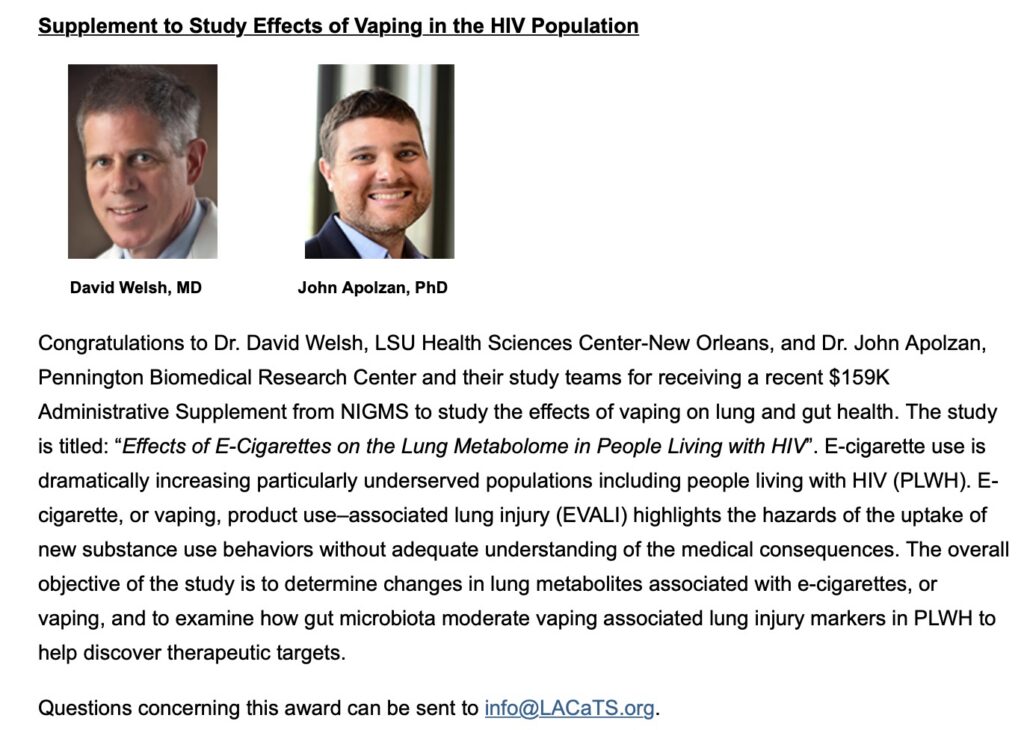
The Louisiana Clinical and Translational Science (LA CaTS) Center is a consortium of the major academic and biomedical research centers in the State of Louisiana. Pennington Biomedical Research Center (PBRC) is the lead LA CaTS institution and will continue to partner with Louisiana State University Health Sciences Center-New Orleans (LSUHSC-NO) and Tulane University Health Sciences […]
JAK/STAT signaling, peripheral insulin resistance, and pathogenesis in the high fat diet model of obesity in Drosophila melanogaster

One major pathogenic mechanism in obesity is aberrant endocrine signaling, which is exemplified by insulin resistance. Once insulin resistance develops in obesity, hyperlipidemia and hyperglycemia can result, which drives forward pathogenesis. During obesity, macrophages are known to modulate insulin sensitivity through the release of cytokines, among them Interleukin-6 (IL-6). IL-6 is a JAK/STAT ligand, which […]